
From the Sensex pack, JSW Steel, Tata Steel, NTPC and UltraTech Cement emerged as major winners, closing the day with a gain of up to 3.33 per cent. On the other hand, Asian Paints, ITC, L&T and SBI were the laggards, ending the session up to 3.95 per cent lower. Of the 30 Sensex stocks, 14 closed the day in green, while on the 50-stock index Nifty 25 scrips ended with gains.

Debates on changing the name of India to Bharat continue to spark a crisis of identity without answering moot questions that stare us in the face. Ramesh Menon asks a few of those questions that do not have easy answers.

"China creeps towards hegemony in Asia, threatens India's borders, and treats other countries as junior partners, Indian-American Congressman Ro Khanna said.

Debroy worked as a consultant in the Department of Economic Affairs in Finance Ministry.

FIIs pump in $1.4 billion in March, after pulling out $2.9 billion in Jan-Feb.

'Valuations of midcaps and smallcaps have reached very high levels, and hence to that extent leave little margin of safety.'

The RBI cracked down on offshore foreign exchange trading by Indians through online trading websites.
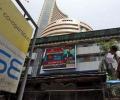
As many as 267 of 453 companies from the BSE500 index are trading above their consensus price targets, according to the data compiled by Bloomberg. Not all companies in the BSE500 index are tracked by analysts.

Among the Sensex firms, UltraTech Cement, Reliance Industries, ICICI Bank, HDFC Bank, Bharti Airtel, IndusInd Bank, State Bank of India, Tata Consultancy Services, Larsen & Toubro, Kotak Mahindra Bank and State Bank of India were the major gainers. In contrast, Tata Motors, Maruti, Axis Bank, Mahindra & Mahindra, ITC, NTPC, Tata Steel and Bajaj Finserv were the major laggards.

Dealers said the sharp recovery of the rupee was because of restrictions imposed by the RBI on forward trading in the local currency by foreign institutional investors and traders, besides the cap fixed on banks' exposure to the forex market.
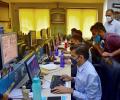
On the Sensex chart, NTPC, SBI, UltraTech Cement, ICICI Bank, Tata Steel, Bajaj Finserv and Bjaja Finance were among the major laggards, shedding as much as 1.63 per cent.

Investor sentiment got a big push after Brent crude, the international benchmark, dropped below the USD 73-mark to quote at a seven-month low of USD 72.65 by falling 3.48 per cent, traders said.

The behaviour of the foreign institutional investors is gauged from the numbers put out by the exchanges and regulators.


The new regulations leave registration capital requirements for wholly foreign-owned banks unchanged
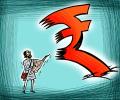
The rupee depreciated 22 paise to a record low of 78.59 against the US dollar in opening trade on Tuesday as persistent foreign funds outflows weighed on investor sentiments. At the interbank foreign exchange, the rupee opened on a weak note at 78.53 against the American dollar, then lost ground to quote at 78.59 -- its all-time low level, registering a fall of 22 paise from the last close. On Monday, the rupee declined by 4 paise to close at its life-time low of 78.37 against the US dollar.
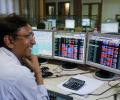
The Sensex jumped 412.23 points on Friday, braving heavy volatility during the day, amid the Reserve Bank of India maintaining status quo on the benchmark lending rate and buying in index heavyweights Reliance Industries Limited and ITC. The BSE Sensex climbed 412.23 points or 0.70 per cent to settle at 59,447.18. During the day, the benchmark hit a high of 59,654.44 and a low 58,876.36. The Nifty also gained 144.80 points or 0.82 per cent to finish at 17,784.35.
Riding on a bull run, equity investors became richer by Rs 128.77 lakh crore in the 2023-24 fiscal, driven by robust fundamentals of the Indian economy, increased investment inflows and promising corporate earnings. After a muted performance in 2022-23, equity markets made a remarkable recovery in FY24, giving handsome returns to investors. The 30-share BSE Sensex climbed 14,659.83 points or 24.85 per cent in 2023-24.

NSE Nifty, after shuttling between 10,809.60 and 10,725.90, finished 30.95 points, or 0.29 per cent lower at 10,741.10.
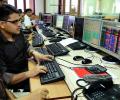
From the Sensex pack, Power Grid, Infosys, Asian Paints, Mahindra & Mahindra, HCL Technologies, IndusInd Bank, Tech Mahindra, Bajaj Finance, Wipro, Tata Consultancy Services, HDFC Bank and Titan were the major gainers. Tata Steel and Bharti Airtel were the laggards.

Rising for the fourth straight day, benchmark indices Sensex and Nifty settled marginally higher after a choppy session on Friday, tracking mixed global trends amid uncertainties on the geopolitical front. The BSE Sensex opened weak and declined 414.44 points to 55,049.95 in opening deals. But within minutes, it pared all its losses and jumped 369.56 points to 55,833.95. Facing volatility, the index finally settled at 55,550.30, higher by 85.91 points or 0.15 per cent.

New Delhi has reached out to Moscow while waiting for a new president in Washington. New Delhi knows well that in international relations, there are no permanent friends or foes, only permanent national interests, points out Dr Rup Narayan Das.

The rupee had closed barely steady at 63.75 on Wednesday.

Benchmark Sensex and Nifty closed at new lifetime high levels on Monday on foreign fund inflows and buying in index majors HDFC Bank and Reliance Industries. The 30-share BSE Sensex jumped 529.03 points or 0.80 per cent to settle at its new all-time closing high of 66,589.93. During the day, it climbed 595.31 points or 0.90 per cent to hit its lifetime intra-day peak of 66,656.20. The NSE Nifty went up by 146.95 points or 0.75 per cent to end at a new record high of 19,711.45.

Removal of this status means India can now enhance customs duties to any level on goods coming from Pakistan.
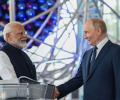
Prime Minister Narendra Modi on Tuesday told Russian President Vladimir Putin that a solution to the Ukraine conflict is not possible on the battlefield and peace efforts do not succeed in the midst of bombs and bullets even as he flagged concerns over a missile strike on a children's hospital in Kyiv.

Macroeconomic data announcements, global factors and trading activity of foreign investors would be the key triggers for the domestic stock markets this week, analysts said. Last week, the benchmark indices joined the broader market's party despite a host of negative global cues. In the broader market, the BSE midcap and smallcap gauges hit their all-time highs on Friday.

Benchmark indices Sensex and Nifty gained around half a per cent to close at nearly five-month high levels on Monday following continuous foreign fund inflows and firm trends in Asian and European markets. Rising for a second straight day, the 30-share BSE Sensex climbed 317.81 points or 0.51 per cent to settle at 62,345.71, the highest closing level since December 14. During the day, it rallied 534.77 points or 0.86 per cent to 62,562.67.

'We emphasise the importance of not basing investment decisions solely on electoral outcomes.' 'Instead, focusing on investing in high-quality businesses capable of prospering regardless of the political landscape is paramount.'

Market participants attribute the stability to the Reserve Bank of India's timely intervention in the foreign exchange market, both in terms of selling and buying dollars.

From the enactment of the capital control Act to the recognition of the BSE as a stock exchange and the infamous Harshad Mehta scam, here are the 18 biggest events for stock markets from 1947 to 1993.

Eighty per cent, or 60 of the 75 companies that made their debut on the mainboard this financial year, ended their listing day with gains.

The sharp rally in the midcap stocks has made valuations expensive, and there is room for a correction, wrote Christopher Wood, global head of equity strategy at Jefferies in his latest note to investors, GREED & fear. The midcap index, Wood said, now trades at 24.1x 12-month forward earnings compared with 18.7x for the Nifty. Rising crude oil prices, he believes, are another worry for India, which imports nearly 80 per cent of its annual crude oil requirement.

'The two sides agree to continue firmly supporting each other in safeguarding their respective core interests,' a joint statement issued at the end of Muizzu's talks with Chinese leaders said.

Why are DIIs holding such a high stake in Zee, which is beset with alleged governance issues? Perhaps they think Zee is a deep-value stock, observes Debashis Basu.

These investors have pumped in about Rs 6,900 crore (Rs 69 billion) in the seven trading sessions after the Federal Open Market Commission meet.

The relationship between the US and India has been very productive, in particular on the trade and technology front, and 2023 can be considered the best year historically for bilateral ties, according to a former top American trade official. Arun Kumar, an Indian-American, who served as the assistant secretary of Commerce for Global Markets and director general of the US and Foreign Commercial Service (USFCS) during the Obama administration, said this during an interview with PTI in Washington. "Looking back on 2023, it was a very productive year for the US-India relationship, by many accounts the best year historically," he said.
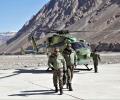
'This reluctance to respond forcefully to Chinese PLA provocations and outright aggression has as much to do with Prime Minister Modi personally, as with the institutional mindset of the MEA or even the Indian Army.' 'They are scarred by the 1962 War and are still cowed by China.'

Equity benchmark indices ended flat on Wednesday with Sensex sliding 33 points and Nifty gaining 9 points after an unabated record-breaking rally in the last few trading sessions. Weak global market trends and fall in HDFC twins also spoiled markets party. The 30-share BSE Sensex dipped 33.01 points or 0.05 per cent to settle at 65,446.04.

From the Sensex basket, Tata Consultancy Services, Nestle, Bajaj Finserv, Wipro, Maruti Suzuki India, Reliance Industries, Larsen & Toubro and NTPC were the major laggards. Tata Steel, Bajaj Finance, JSW Steel and Bharti Airtel were among the gainers.
